
Chasing Victory: Skyler Fisher’s Journey of Strength on and off the Course
Published March 30, 2026
Patient Perspectives
When Skyler Fisher was growing up, there always seemed to be a simple explanation for why she would get hurt more than other kids: she was “clumsy.” While she was able to run and play volleyball with her friends, she often sprained her ankles, spent months in walking boots and casts, and worked hard in physical therapy to strengthen what physicians believed were just weak ankles. When her ankles did not improve, she and her family sought the opinion of an orthopedic physician, who confirmed there was nothing broken or structurally wrong with her ankles but did not have an explanation for her symptoms.

Then, as she entered middle school, things changed. She began to experience tingling and pain in her legs. When the tingling and pain became so serious that it was difficult for her to walk, her family brought her to the emergency room, where doctors became concerned that she might have Guillain-Barré syndrome, a serious condition that can affect the nerves. She went through a spinal tap, blood tests, and a week in the hospital. Despite the extensive tests, being seen by multiple neurologists, and being referred to an out-of-state medical center for more extensive evaluation, they were still without answers and without a diagnosis.
The turning point came a year later, when Skyler was 15 years old. A local neurologist noticed subtle changes in the muscles and nerves of her lower legs and feet during a routine exam and ordered genetic testing. When the results came back, Skyler finally had a name for her condition: Charcot-Marie-Tooth disease (CMT), type 2A, a hereditary disorder that affects the peripheral nerves. Though her family has a background of medical knowledge, with her mother being an occupational therapist, Skyler says her CMT didn’t present in a way her mother was familiar with or how it appeared in searches online. “I feel like my case didn't present as typical CMT, and that made it challenging,” she said. “I didn't have any foot deformities or anything that, and that’s what you see when you Google CMT.”
For many people, receiving a diagnosis of a chronic, progressive condition can be devastating, but for Skyler and her family, the first feeling was relief. After years of not knowing, they finally understood why her body felt different. “It was happy tears, not, oh my god, my life is ending’ — but ‘oh, this is okay, finally, we know what’s happening.’” Getting additional information specifically about CMT type 2A helped them connect the dots to symptoms she’d had since childhood.
Though she doesn’t mind people asking questions about her condition and thinks awareness is important, Skyler shares the difficulty of explaining a rare disease that many people know nothing about. “When I'm trying to explain it to people, I say that I have a genetic neuromuscular disorder because if you say Charcot-Marie-Tooth, they’re confused and think something is wrong with your teeth,” she laughs. “But I just say that the nerves in my legs have a slower pathway than a normal person would have.”
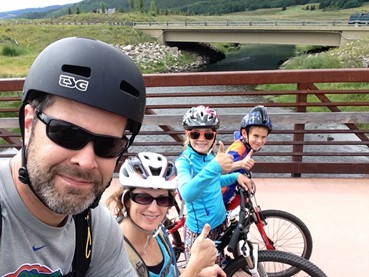
At 21, Skyler lives with the symptoms of CMT—some that people can see and some they can’t. Her balance and coordination are not what they once were. She can no longer run, and on family hikes she often finds herself a few steps behind. She also experiences significant nerve pain, a symptom that disrupts even the most basic daily tasks, like sleeping.
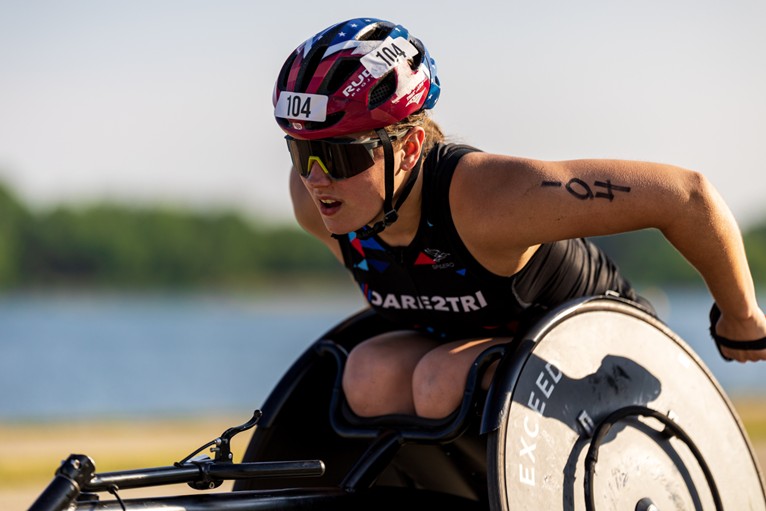
And while these symptoms may impact her life, they’re not stopping her from excelling at life. Skyler remains deeply active and engaged in sports. As a child, she was a competitive swimmer and loved the water. After her diagnosis, she transitioned to paraswimming and competed at national-level events. Eventually, she was introduced to paratriathlon, which combines swimming, cycling, and running in adapted forms.
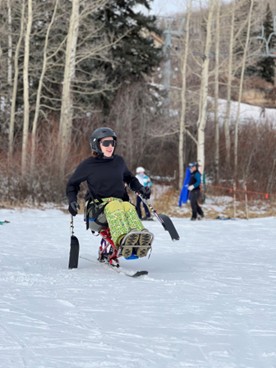
“Sure, there are things I can't do, but I find a way to make it work,” she says. Skyler now uses a racing wheelchair for the run portion of races and a handcycle instead of a traditional bicycle. These adaptations allow her to continue to compete at a high level while respecting what her body can and cannot do. She trains at the Olympic Training Center and was the first alternate for the Paris 2024 Paralympic Games. She aims to represent the United States at the 2028 Paralympic Games in Los Angelas in paratriathlon.
Skyler’s success is supported by a strong network of family, friends, coaches, and sports medicine professionals. Together, they adjust her training when needed, help manage pain and fatigue, and make sure her health remains the top priority.
Outside of competition, Skyler is an advocate for others living with CMT and neuromuscular disorders. She raises awareness by sharing her experiences on social media and serves on the CMT “Dream Team” through a patient advocacy organization. Skyler believes her own experience with years of uncertainty and invasive tests might have been shorter if her symptoms were recognized earlier, and genetic testing had been used sooner. She urges physicians to recognize symptoms sooner and to consider genetic testing earlier in the diagnostic process for suspected neuromuscular conditions.
 Though she acknowledges the challenges the future may hold with a progressive illness like CMT, and the implications the genetic disease may have if she were to have children, Skyler remains optimistic about medical advancements. “I’m excited about the clinical trials and research that they're doing around the different types of CMT. There are so many different types, but they're researching each of them. And the clinical trials where they're trying to find medicine that either slows the progression or just cures the disease eventually makes me hopeful for the future.”
For people living with CMT or other neuromuscular disorders, Skyler offers a message of encouragement: stay as active as you safely can and do not be afraid to adapt activities to fit your body. With today’s technology, equipment, and creative problem-solving, there are many ways to move, participate, and pursue goals. Her journey shows that while a diagnosis of CMT changes many things, it does not erase the possibility of a full, active, and meaningful life.